
Engineering Challenge Series
Forge 2
Thirty teams. Two weeks. Build a working mechanical, robotic, mechatronic, or automation prototype for sustainable healthcare in the UAE.
- Kickoff
- Oct 31
- Deadline
- Nov 14
- Duration
- 2 Weeks
- Team size
- 1 to 3
- Format
- Online
The Challenge
What You Build
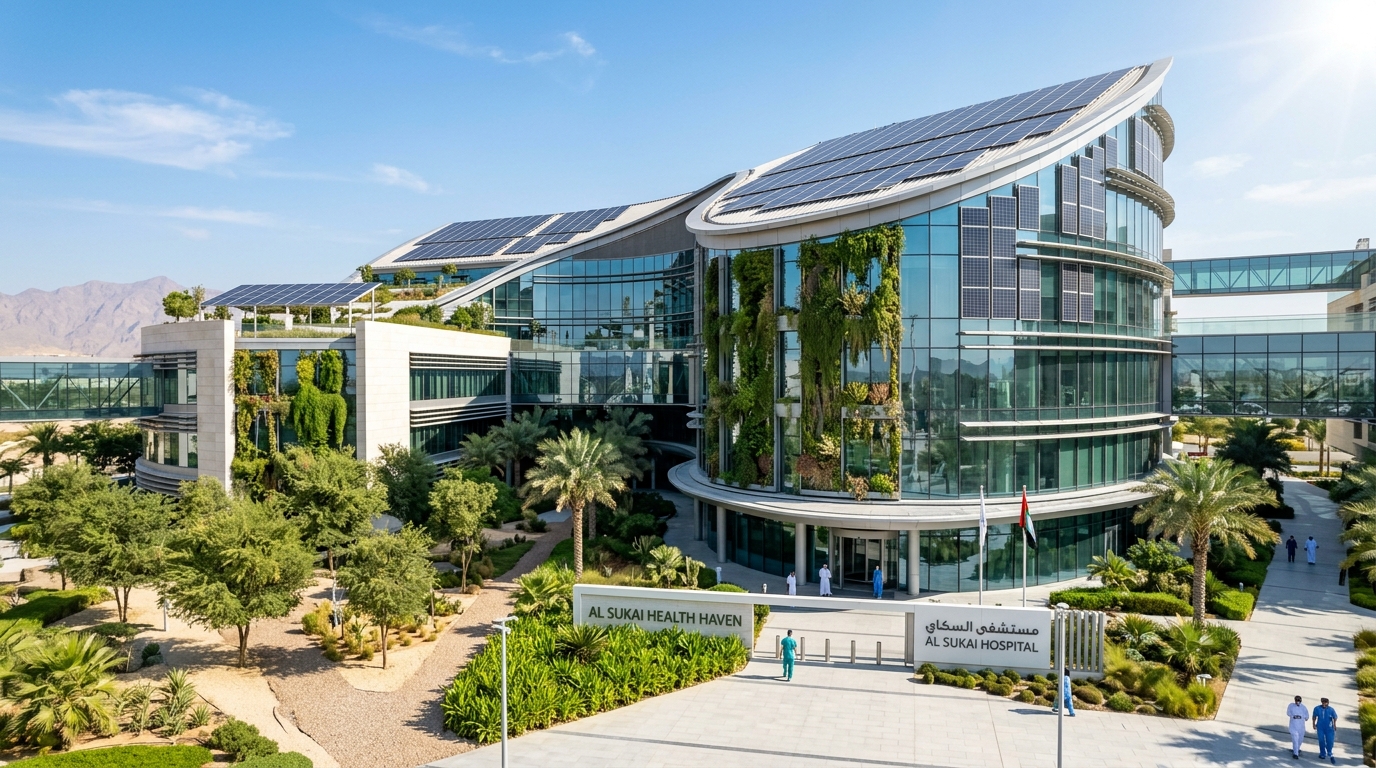
Engineering Sustainable Healthcare by 2050.
The UAE has placed sustainability at the core of national development, anchored by the UAE Net Zero by 2050 strategic initiative and the historic COP28 UAE Declaration on Climate and Health.
Healthcare facilities demand massive amounts of power, chilled water, specialized materials, and continuous sterilization. Forge 2 challenges engineering students to invent the mechanical, mechatronic, and robotic systems that will power net-zero hospitals.

The UAE's largest integrated healthcare network, committed to reaching net-zero emissions by 2040. The first Middle Eastern healthcare provider in the UN Race to Zero, deploying on-site solar systems across hospitals and AI facility energy optimization.

Abu Dhabi-headquartered global health powerhouse backed by Mubadala, committed to Net Zero 2050 through sustainable clinical infrastructure, high-efficiency equipment engineering, and green technology partnerships worldwide.
National & Global Benchmarks
The Healthcare Decarbonization Imperative
Global healthcare operations account for ~4.4% of total worldwide greenhouse gas emissions — equivalent to 514 coal-fired power plants.
Hospitals consume over 2.5× more energy per unit area than commercial buildings, driven by intensive 24/7 cooling and ventilation in the Gulf climate.
Targeted reduction in UAE healthcare carbon emissions by 2030 under the National Climate and Health Framework leading to Net Zero by 2050.
Average daily medical and hazardous waste produced per hospital bed, demanding circular sterilization, modular repairability, and volume reduction.
Pick a problem from one of these areas
- Energy-efficient healthcare infrastructure & smart facility automation
- Sustainable cooling, ventilation, and thermal management
- Mechanical systems supporting renewable energy and solar integration
- Climate-resilient healthcare infrastructure and HVAC optimization
- Automated hospital logistics and intra-facility transport
- Sustainable medical supply transportation and cold-chain integrity
- Robotics that reduce inefficient manual processes and staff strain
- Healthcare waste handling, segregation, and volume reduction
- Water-efficient healthcare and hospital water recovery systems
- Resource-efficient sterilization, autoclaving, and cleaning systems
- Reusable or modular medical equipment designed for fast servicing
- Equipment engineered for repairability and longer service life
- Circular design, component disassembly, and material recovery
- Sustainable rehabilitation, biomechanical, or assistive mobility devices
- Low-power mechatronic assistive mechanisms for patients and staff
- Ergonomic patient-transfer and motorized clinical support systems
It can be any kind of solution
- Mechanical devices
- Robotic systems
- Automated mechanisms
- Mechatronic systems
- Medical or rehabilitation devices
- Smart healthcare equipment
- Sustainable infrastructure systems
- Material-handling or logistics systems
- CAD-based engineering prototypes
- Functional physical prototypes
- Simulated mechanical systems
- Any other engineering solution that advances sustainable healthcare
Deliverables
What You Submit
Submit a Google Drive folder link containing your Project Document, 7-minute Demonstration Video, and Engineering Prototype files.
- 0101 — A Project DocumentDescribe the sustainability challenge you identified, why it matters within the UAE healthcare landscape, your proposed engineering solution, and how it works. Include: the problem being addressed, its relevance to sustainability and healthcare in the UAE, design requirements and constraints, mechanical or mechatronic design, materials and major components, how the system operates, engineering calculations or technical justification where relevant, safety considerations, sustainability benefits, and limitations and future improvements. Write the document as if you are explaining your project to someone with a general engineering background.
- 0202 — A Demonstration VideoA demonstration video, maximum 7 minutes, uploaded to the same Google Drive folder. Walk through: (1) The healthcare sustainability challenge, (2) Why it is relevant to the UAE, (3) Your proposed solution, (4) How the mechanism or system works, (5) Your engineering design decisions, (6) Prototype, CAD model, or simulation walkthrough, and (7) Expected environmental and healthcare impact.
- 0303 — An Engineering PrototypeInclude a prototype that demonstrates or validates the core engineering principles of your proposed solution. Examples include: a functional physical prototype, a scaled engineering model, a robotic prototype, a mechatronic system, a CAD assembly accompanied by engineering analysis, a mechanical simulation (motion or kinematic simulation, structural or load analysis), an electronics/control system prototype, or a combination of physical and simulated components. A fully manufactured final product is not required; however, your submission should provide enough technical evidence to demonstrate that the proposed solution is mechanically feasible and could realistically be developed further.
- 1.Locked files. Make sure your Google Drive folder and all files inside are set to "anyone with the link can view." If the judges cannot open your work, you will receive a zero.
- 2.Going over time. Your demonstration video must be under seven minutes. Keep your engineering walkthrough concise, structured, and focused on mechanism and impact.
- 3.Visuals without mechanical validation. A CAD render alone is not enough. Your prototype must validate core engineering principles — via kinematic simulations, FEA stress analysis, thermodynamic/fluid calculations, or a physical bench prototype.
- 4.Skipping technical calculations. Don't just state what your system does; justify how it works. Clearly present engineering calculations, motor/actuator sizing, material selection rationale, and operating parameters in your document.
- 5.Vague sustainability claims. Avoid vague claims like "eco-friendly" or "green." Quantify your environmental benefits: estimated kWh of electricity saved, liters of water recovered, or kg of medical plastic diverted.
- 6.Ignoring healthcare safety & clinical constraints. Hospital environments have rigorous hygiene, sterility, and safety standards. Address fail-safes, maintenance intervals, biocompatibility, and operational regulations.
Evaluation
How You're Scored
This is the full rubric out of 50 points, evaluated by the Technical Engineering Judge, Healthcare & Sustainability Judge, and Business & Design Judge.
- Clearly defines a real sustainability challenge within healthcare3
- Explains why the problem is significant within the UAE3
- Demonstrates understanding of the healthcare environment and stakeholders affected2
- Proposed solution directly addresses the identified problem2
- The interface and user journey are intuitive, accessible, and appropriate for the intended users.3
- The solution offers a clear point of difference, with features and design choices that support the problem being solved.2
- The team clearly explains who benefits, what value the solution provides, and why the intended users would adopt it.2
- The team identifies a plausible route to use or adoption, considering relevant stakeholders, practical constraints, and sustainability.2
- The chosen technology meaningfully supports the user experience and solution, rather than being included for novelty alone.1
- Prototype, model, or simulation clearly demonstrates the core mechanism5
- Engineering design is technically sound3
- Prototype provides meaningful validation rather than serving only as a visual concept3
- Technical complexity reflects meaningful engineering effort2
- Team demonstrates clear understanding of the engineering principles involved2
- Solution is technically and operationally feasible3
- Demonstrates a clear sustainability benefit3
- Could reasonably be implemented or scaled within UAE healthcare environments2
- Team identifies realistic limitations, safety concerns, or future improvements2
- The presentation is organised, concise, clear, and within the allotted time.2
- The demonstration clearly shows the product's core user journey, while the verbal delivery communicates its value confidently and convincingly.3
Judging philosophy
Forge is a builder's competition. Communication matters, but technical execution, mechanical feasibility, and quantifiable sustainability impact carry the greatest weight.
Timeline
The Dates
You have fourteen days to design, simulate, prototype, and submit your engineering solution.
- Oct 31, 2026Kickoff & Challenge launch. The brief goes live at the start of the 2-week sprint.
- Oct 31–Nov 142-Week Engineering Sprint. Research, design CAD assemblies, simulate, prototype hardware, and collaborate.
- Nov 14, 2026Submission Deadline at 11:59 PM. Google Drive folder link submitted via official form.
- Nov 15–21Judging Period. Technical engineering, healthcare and sustainability, and business and design judges evaluate submissions.
- November 2026Winners Announced across MedHack's website, LinkedIn and Instagram.
Worked Example
An Example Submission
This is an example submission
Everything below is made up. Don't build this one. It just shows what a finished submission looks like. Yours is one Drive folder with three things in it: a Project Document, an Engineering Prototype, and a video.
1 · The Drive folder
Shared so anyone with the link can view. It holds your three files.
- 01_Sustainable_Autoclave_Project_Document.pdfProject Document · PDF
- 02_Engineering_Pitch_and_Demonstration.mp4Demonstration Video · 6:40 min
- 03_Engineering_Prototype_CAD_and_Simulations.zipCAD & Simulation · SolidWorks
2 · What goes inside the Project Document
Explain the problem and your solution, and include your prototype link at the top.
Closed-Loop Thermal & Water Recovery Autoclave for UAE Surgical Suites
Forge 2 | Team EcoThermic (Mechanical & Mechatronics Engineering)
https://cad-cloud.engineering/medhack-forge2-autoclave-v3
UAE hospitals run steam autoclaves 24/7 for surgical instrument sterilization, discharging superheated condensate and consuming thousands of liters of RO-desalinated water weekly while rejecting high thermal loads into hospital HVAC systems.
Hospital sterilization cycles operate as open thermodynamic loops, wasting high-grade thermal energy and pure distilled water in an arid desert climate where desalination and chilled-water cooling carry high carbon footprints.
With extreme summer ambient temperatures (+45°C), hospital HVAC chillers operate near peak capacity. Internal heat rejected by CSSD sterilization units forces cooling systems to consume excessive electrical power.
Central Sterile Services Departments (CSSD), hospital facilities and energy managers, and regional utilities striving to meet UAE Net Zero 2050 targets.
Surgical sterilization standards (134°C at 2.1 bar) cannot be compromised. Any recovery loop must remain isolated from biological contaminants, prevent cross-infection, and comply with ASME boiler and medical pressure vessel safety codes.
A mechatronic closed-loop autoclave attachment integrating a counter-flow titanium heat exchanger, a high-temperature thermoelectric recapture stage, and a closed-circuit condensate filtration loop that recycles 85% of steam condensate back into boiler feed water.
A functional mechatronic bench test rig and SolidWorks CAD assembly with CFD/thermal transient simulations proving an 82% water recovery rate and a 34% reduction in net cycle electrical power draw.
Deionization filtration cartridges require scheduled maintenance every 250 cycles to prevent mineral scaling on heating elements, and retrofitting older autoclave models requires an external bypass valve manifold.
3 · The Engineering Prototype
CAD assemblies, simulations, or functional hardware that validates your core mechanism.
4 · The Demonstration Video
A screen recording, maximum 7 minutes. Your video must be a pitch: not simply a demonstration of your prototype. Present your project in order: (1) The Problem, (2) The UAE Context, (3) The Solution, (4) The Technology & Engineering Design, (5) Prototype Demonstration, (6) Expected Impact.
The Advice
Spend most of your time on the problem
Thirty teams submit. One wins. The other twenty-nine still ship a working prototype in two weeks. Nobody who submits loses.
Questions & submission
Questions and help
Ask everything in the Forge community. Answers are posted there so everyone can see them.